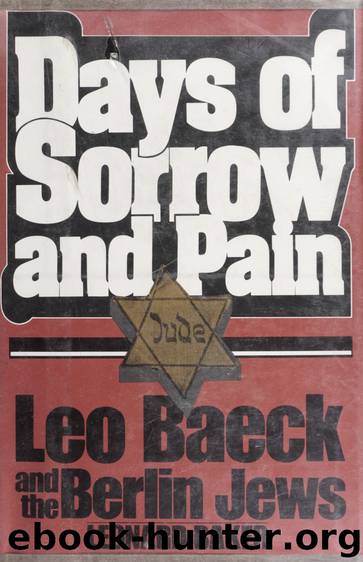
Days of sorrow and pain : Leo Baeck and the Berlin Jews by Baker Leonard
Author:Baker, Leonard
Language: eng
Format: epub
Tags: Baeck, Leo, 1873-1956, Rabbis, Jews
ISBN: 0195028007
Publisher: New York : Macmillan
Published: 1978-03-13T16:00:00+00:00
Little by little. That is how the survivors of the Berlin Jewish com-munity describe the Nazi attack upon them. First, a Jewish lawyer couldnot practice unless he had been a lawyer prior to 1914 or had served inthe First World War. Emil Fackenheim's father met both these condi-tions; still the Nazis disbarred him, claiming he had defended someCommunists in 1918-1919. In 1933 the Nazis enacted forty-two lawsrestricting the Jews' rights to earn a living, to enjoy full citizenship, andto educate themselves. In 1934 there were nineteen such laws, twenty-nine in 1935, twenty-four in 1936, twenty-two in 1937, and seventy-eight in 1938. Clothed in the mantle of law, the Nazis acted arbitrarily,aggressively, immorally, and sometimes violently against the Jews. "Youcouldn't murder anyone in Germany," said Emil Fackenheim, "unlessthe law allowed you. The weakness of men is that they fall into thattrap." Robert Weltsch recalled, "When the doorbells rang, we werenever certain who it would be. Someone to take us away? Would weever be seen again? Often we watched through curtained windows tosee where the Nazi patrols were going, whom they were going to arrest."1
Between 1933 and 1938 the most significant of the laws enactedagainst the Jews were those referred to as the Nuremberg laws. Theybegan, in September 1935, as laws "for the protection of German bloodand honor," prohibiting marriage as well as extramarital intercoursebetween Jew and non-Jew. Then, at Hitler's sudden order, the laws werebroadened to include a new definition of German citizenship: Jews orthose with Jewish ancestry no longer were German citizens.
Hitler appeared to change his mind about the Jews on occasion. In
200
1936, the year following enactment of the Nuremberg laws, Germanywas host to the Olympics. For Germany the event was a twofold oppor-tunity, to show off the athletic prowess of the Nazi "superman" and togain stature in the world by having the other nations accept Nazi Ger-many as the Olympics site. There was little difficulty with this secondpoint. Most nations, arguing that sports and not politics was involvedin the Olympics, accepted Germany as the site of the event. To allaysome sensitivities, however, anti-Semitic posters disappeared from wallsand Der Sturmer, the anti-Semitic newspaper, vanished during theOlympics. For a period the entire anti-Semitic campaign faded. "Nothinghappened to the Jews then," recalled Werner Rosenstock, a Reichsver-tretung official. "That was a boon in itself."2
But that was only a respite. On March 13, 1938, the Nazis took awaythe public status of Jewish associations. Jews no longer were membersof their Jewish communities. The state no longer collected taxes for theJewish communities for redistribution to Jewish agencies. The com-munities no longer enjoyed tax exemptions. The Gemeinde was dead.As president of the Reichsvertretung, Baeck called upon German Jewsto continue their loyalties to the Jewish communities, to pay taxes directto the communities, and to give the community offices full support. Hismessage was, in effect, that nothing has changed. Privately, however,officials were more concerned. Otto Hirsch, in a discussion about thesituation a few weeks later, said: "All is lost."
That year the Nazis enacted a law requiring male Jews to assumethe name of Israel and all female Jews to take the name of Sarah.
Download
This site does not store any files on its server. We only index and link to content provided by other sites. Please contact the content providers to delete copyright contents if any and email us, we'll remove relevant links or contents immediately.
Fanny Burney by Claire Harman(26660)
Empire of the Sikhs by Patwant Singh(23135)
Out of India by Michael Foss(16985)
Leonardo da Vinci by Walter Isaacson(13411)
Small Great Things by Jodi Picoult(7224)
The Six Wives Of Henry VIII (WOMEN IN HISTORY) by Fraser Antonia(5557)
The Wind in My Hair by Masih Alinejad(5138)
A Higher Loyalty: Truth, Lies, and Leadership by James Comey(5017)
The Crown by Robert Lacey(4862)
The Lonely City by Olivia Laing(4841)
Millionaire: The Philanderer, Gambler, and Duelist Who Invented Modern Finance by Janet Gleeson(4538)
The Iron Duke by The Iron Duke(4405)
Papillon (English) by Henri Charrière(4322)
Sticky Fingers by Joe Hagan(4253)
Joan of Arc by Mary Gordon(4156)
Alive: The Story of the Andes Survivors by Piers Paul Read(4077)
Stalin by Stephen Kotkin(4004)
Aleister Crowley: The Biography by Tobias Churton(3671)
Ants Among Elephants by Sujatha Gidla(3494)
